North Dakota · County profile
Crime Map, Crime Rate, and Safety Score for Pierce County, North Dakota
Explore neighborhood Safety Scores in Pierce County, compare its ZIP codes, and find wider local context.
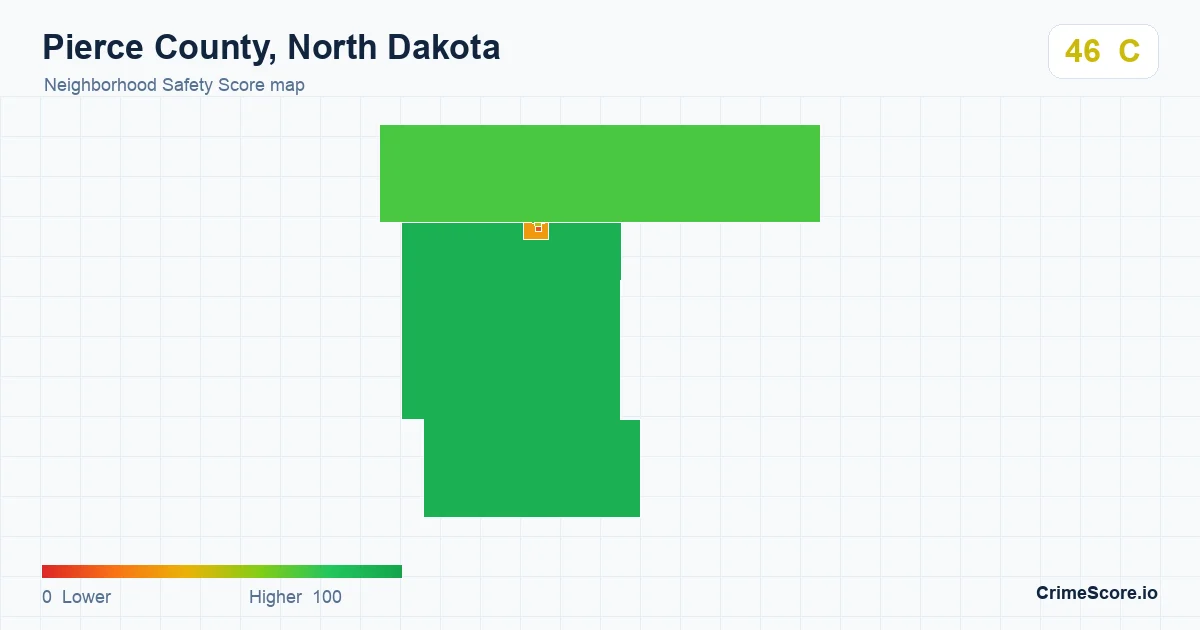
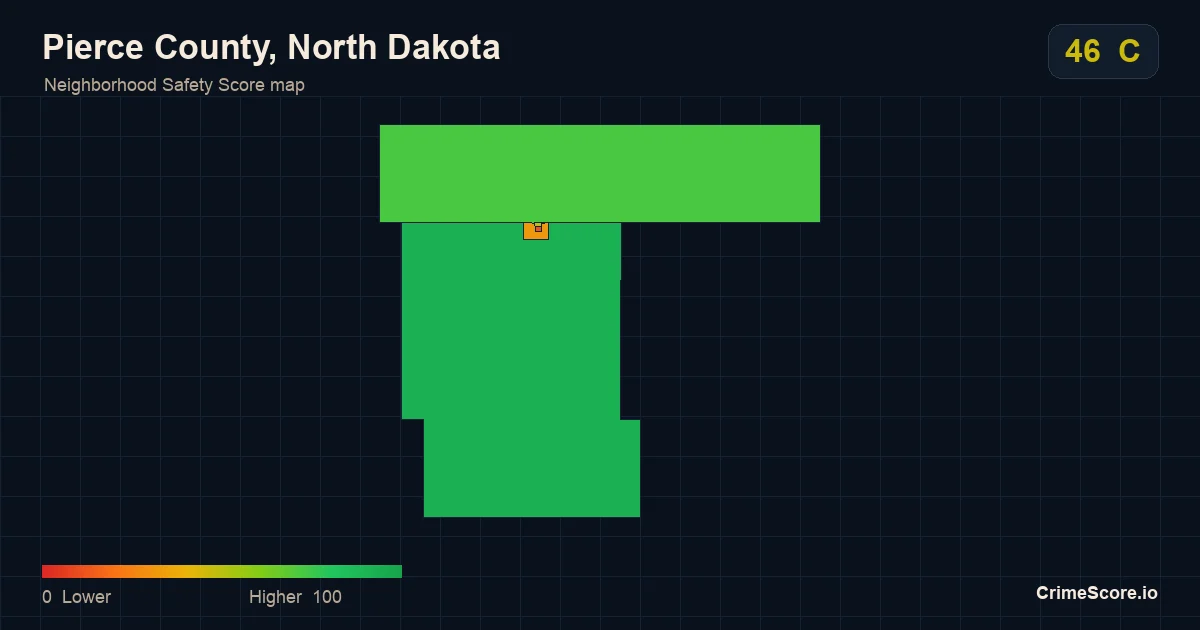
Explore scored neighborhoods across Pierce County. Areas without available scores remain unscored.
Is Pierce County, North Dakota safe?
Pierce County, North Dakota has a CrimeScore county Safety Score of 46 out of 100, grade C, higher (safer) than 46% of US counties. Higher scores indicate safer modeled conditions. Its ZIP codes range from 47 to 92, so the answer depends on the neighborhood. Safety Scores are modeled estimates, not official crime rates.
Compare ZIP profiles in Pierce County
All 3 ZIP profiles assigned to this county, listed by ZIP code. ZIP boundaries can cross county lines; assignment uses the primary county.
Across these ZIP profiles, Safety Scores range from 47 to 92.
Showing all 3 ZIP profiles
Higher scores indicate safer modeled conditions. Scored areas are Census block groups, not a coverage percentage.
County and ZIP scores describe different areas. The county score is not an average of this table.
About Pierce County
Pierce County, North Dakota is a smaller county market, with an estimated 3,928 residents across 1,854 households.
Owner-occupied housing makes up the larger share of occupied homes at 81.6%, while renter-occupied housing accounts for 18.4%.
The county profile also covers broad socioeconomic context: a poverty rate of 10.4%, an unemployment rate of 1.1%, and bachelor's degree or higher attainment of 28.2%.
Commute context is included as well, with 2.4% of workers reporting commutes of 60 minutes or more.
CrimeScore pairs this county profile with neighborhood-level Safety Scores and block-group map layers so teams can compare local areas inside Pierce County without relying on one broad county-level view.
Explore local detail
Each colored area on the map is a Census block group. Select an area to see its Safety Score and grade. A county-wide score is a starting point; compare smaller areas for local differences.
For product teams