Tennessee · County profile
Crime Map, Crime Rate, and Safety Score for Giles County, Tennessee
Explore neighborhood Safety Scores in Giles County, compare its ZIP codes, and find wider local context.
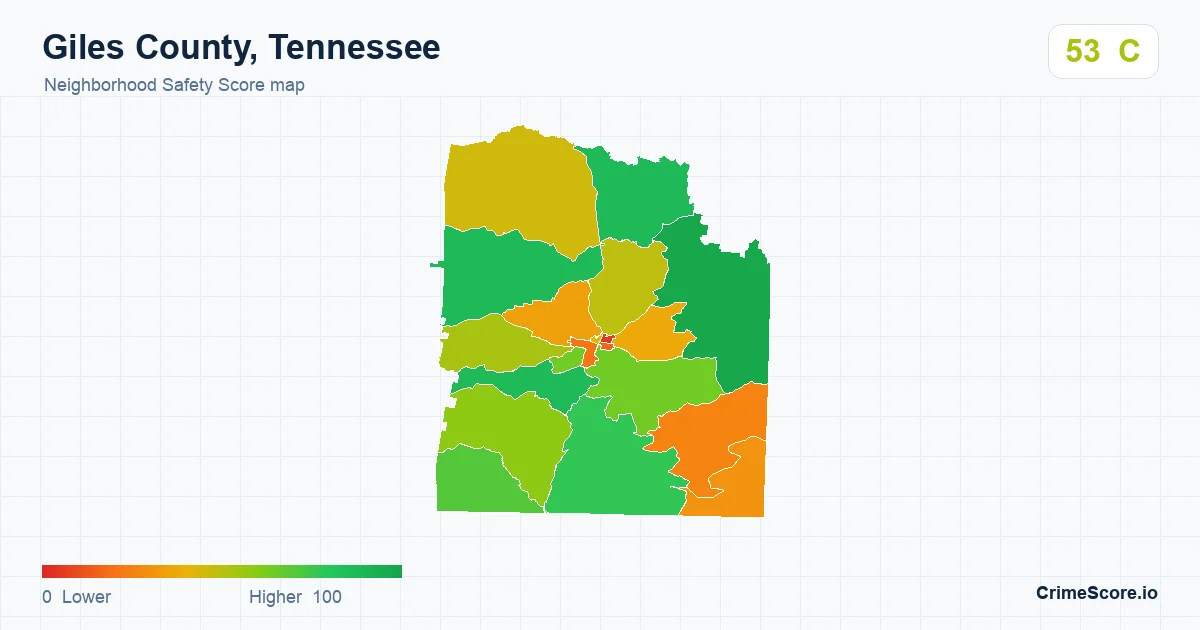
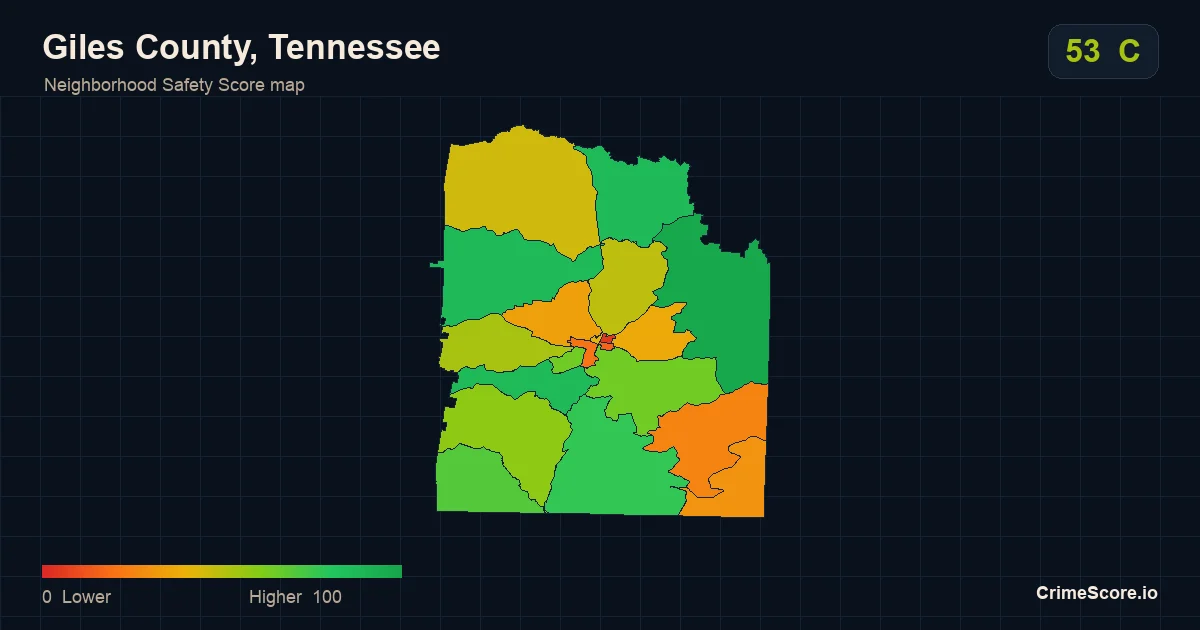
Explore scored neighborhoods across Giles County. Areas without available scores remain unscored.
Is Giles County, Tennessee safe?
Giles County, Tennessee has a CrimeScore county Safety Score of 53 out of 100, grade C, higher (safer) than 53% of US counties. Higher scores indicate safer modeled conditions. Its ZIP codes with at least 5 scored block groups range from 49 to 67, so the answer depends on the neighborhood. Safety Scores are modeled estimates, not official crime rates.
Compare ZIP profiles in Giles County
All 6 ZIP profiles assigned to this county, listed by ZIP code. ZIP boundaries can cross county lines; assignment uses the primary county.
Across these ZIP profiles, Safety Scores range from 25 to 70.
Showing all 6 ZIP profiles
Higher scores indicate safer modeled conditions. Scored areas are Census block groups, not a coverage percentage.
County and ZIP scores describe different areas. The county score is not an average of this table.
About Giles County
Giles County, Tennessee is a smaller county market, with an estimated 30,620 residents across 12,058 households.
Owner-occupied housing makes up the larger share of occupied homes at 73.3%, while renter-occupied housing accounts for 26.7%.
The county profile also covers broad socioeconomic context: a poverty rate of 13.3%, an unemployment rate of 4.4%, and bachelor's degree or higher attainment of 20.1%.
Long commutes are a notable local context signal here, with 15.3% of workers reporting commutes of 60 minutes or more.
CrimeScore pairs this county profile with neighborhood-level Safety Scores and block-group map layers so teams can compare local areas inside Giles County without relying on one broad county-level view.
Explore local detail
Each colored area on the map is a Census block group. Select an area to see its Safety Score and grade. A county-wide score is a starting point; compare smaller areas for local differences.
For product teams